
An upgrade to bizSAFE STAR isn’t just a renewal of your Level 3 status; it’s a complete transformation of how your business protects its people. While bizSAFE Level 3 focuses on managing specific risks, the bizsafe level 3 to star upgrade requires you to build a holistic Workplace Safety and Health Management System (WSHMS) that meets international standards like ISO 45001. With over 43,000 companies in Singapore already recognized under the bizSAFE program as of 2026, the competition for major government and private tenders has never been tighter.
We understand that moving from simple risk management to a full-scale audit can feel overwhelming. You might be worried about the rigorous requirements of SS 651 or wondering if your current documentation will stand up to a third-party auditor’s scrutiny. That’s why we’ve created this expert roadmap to help you master the transition with confidence. In this guide, we’ll break down the certification requirements, explain the timeline for your upgrade, and provide a clear path to a streamlined, audit-ready system that wins you more business.
Key Takeaways
- Understand how bizSAFE STAR moves beyond basic risk management to a full-scale Workplace Safety and Health Management System.
- Learn why securing ISO 45001 or SS 651 certification is a mandatory prerequisite for a successful bizsafe level 3 to star upgrade.
- Discover the shift from simple safety meetings to strategic management reviews and how this affects your daily documentation requirements.
- Follow a clear five-step roadmap that begins with a gap analysis to identify exactly where your current systems need improvement.
- See how professional consultancy and the provision of WSHE professionals can streamline your audit preparation and ensure long-term compliance.
Understanding the Leap: BizSAFE Level 3 vs. BizSAFE STAR
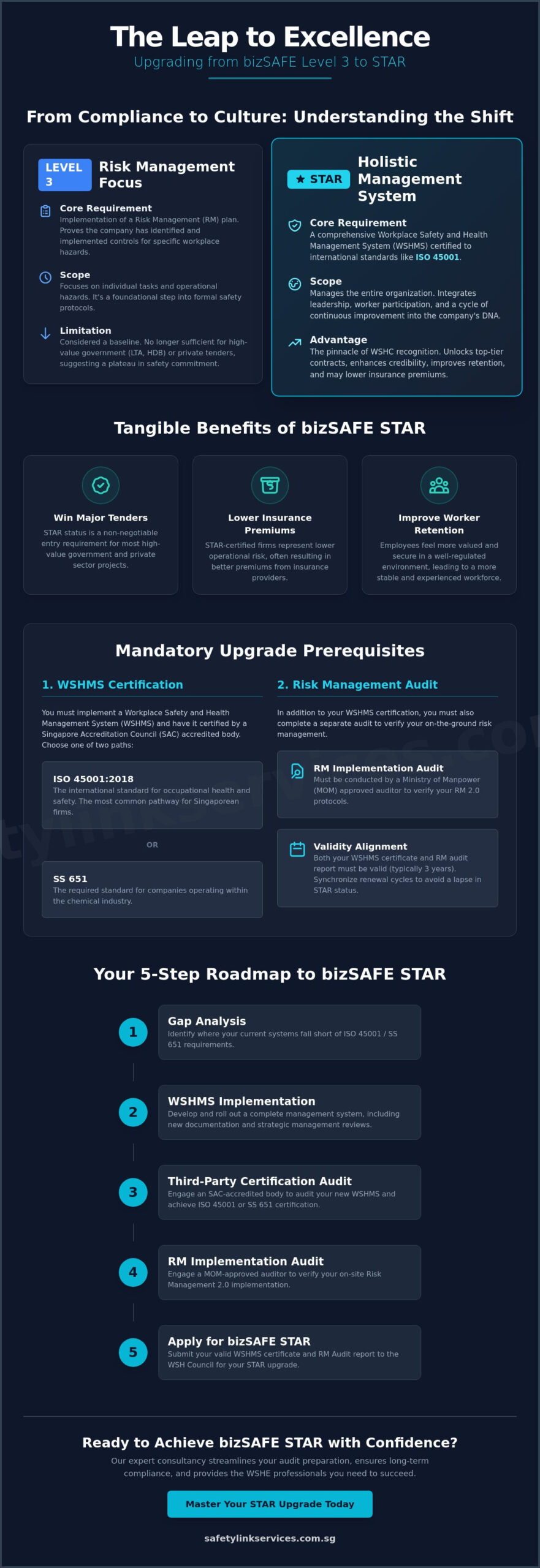
BizSAFE Level 3 is the standard baseline for risk management (RM) compliance in Singapore. It proves that your company has identified workplace hazards and implemented the necessary controls to mitigate them. For many small businesses, this level is their first real step into formal safety protocols. However, a bizsafe level 3 to star upgrade represents a significant jump from managing individual tasks to managing an entire organization. It is the pinnacle of the programme administered by the Workplace Safety and Health Council (WSHC).
The core difference lies in the scope of your safety efforts. While Level 3 focuses on the implementation of a Risk Management plan, STAR requires a holistic Workplace Safety and Health Management System (WSHMS). This system doesn’t just look at hazards; it looks at leadership, worker participation, and continuous improvement. In the 2026 regulatory landscape, this distinction is critical. Singaporean authorities and major developers no longer just want to see that you have a risk register; they want to see a living system that evolves to prevent accidents before they happen.
Why BizSAFE Level 3 is no longer enough for growth
If your business is looking to scale, staying at Level 3 can actually hold you back. Major government agencies like the Land Transport Authority (LTA) and the Housing & Development Board (HDB) have increasingly strict safety requirements. Most high-value tenders now mandate STAR status as a non-negotiable entry requirement. It acts as a vital pre-qualification for Tier 1 contractors who need to ensure their entire supply chain is robust. MOM’s focus has shifted toward proactive safety cultures; being stuck at Level 3 might suggest to potential partners that your safety journey has reached a plateau rather than striving for excellence.
The “STAR” Advantage: Credibility and Compliance
Moving to STAR status brings tangible benefits that go beyond just winning contracts. A comprehensive management system often leads to improved worker retention because employees feel more secure in a well-regulated environment. You might also see a positive impact on your bottom line; many insurance providers in Singapore offer better premiums to STAR-certified firms because they represent a lower operational risk. There is also the undeniable prestige of being recognized by the WSHC as a top-tier safe organization. BizSAFE STAR status is the ultimate commitment to achieving a zero-harm workplace for every member of your team.
The Technical Prerequisites for a BizSAFE STAR Upgrade
Achieving a bizsafe level 3 to star upgrade isn’t just a matter of submitting paperwork; it requires your business to meet specific technical benchmarks. According to the official bizSAFE program overview, the STAR level is reserved for companies that have fully integrated a Workplace Safety and Health Management System (WSHMS). This means you must move beyond the basic risk management required at Level 3 and adopt a more rigorous, audited framework.
To qualify, your company must follow one of two primary pathways. Most Singaporean firms choose the ISO 45001:2018 standard, which is the international benchmark for occupational health and safety. However, if your business operates within the chemical industry, the SS 651 standard is the required route. Regardless of the path you choose, your WSHMS must be audited and certified by a Singapore Accreditation Council (SAC) accredited Certification Body (CB). This ensures that your safety systems meet the highest possible standards of reliability and transparency.
One detail that often surprises business owners is that a bizsafe level 3 to star upgrade still requires a separate Risk Management (RM) Implementation Audit. Even if you have your ISO certification, you must engage a MOM-approved auditor to verify that your RM 2.0 protocols are active on the ground. Both your ISO/SS 651 certificate and your RM audit report must be valid and aligned. Since both certifications typically have a three-year validity period, it’s vital to synchronize your renewal cycles to avoid a sudden lapse in your STAR status.
ISO 45001: The Global Standard for STAR
Transitioning from Level 3 often reveals gaps in how a company views its organizational context. ISO 45001 requires you to look at external and internal factors that affect safety, such as legal requirements or company culture. Another critical area is worker participation. Auditors will look for evidence that your employees aren’t just following rules but are actively involved in identifying hazards and suggesting improvements. When you’re ready to start, we recommend choosing an auditor who understands your specific industry nuances to ensure a smooth certification process.
The RM Implementation Audit Report
The RM audit is the final hurdle. It focuses on the practical application of your risk assessments. Many companies fail this part because their documentation doesn’t match their actual worksite practices. Common pitfalls include outdated RA records or a lack of evidence for safety training. If you’re concerned about your current documentation, our team can provide Risk Assessment Assistance to help you refine your records and ensure they meet the strict requirements of MOM-approved auditors.
Comparative Analysis: What Changes in Your Daily Operations?
Moving forward with a bizsafe level 3 to star upgrade changes the “safety rhythm” of your office and worksite. At Level 3, your primary focus is on risk management at the task level. You likely spend most of your time ensuring Risk Assessments (RAs) and Safe Work Procedures (SWPs) are updated for specific jobs. However, STAR status shifts the focus toward a system-wide approach. You aren’t just managing hazards; you’re managing a culture. This means your daily operations will move from reactive task-checking to proactive system monitoring.
The documentation load is one of the most visible changes. While Level 3 requires a solid risk register, STAR demands a comprehensive set of manuals, policies, and measurable objectives. You’ll need to track safety performance indicators, such as near-miss frequencies or training completion rates. Another major shift happens in the boardroom. Instead of just standard safety committee meetings, you’ll conduct formal “Management Reviews.” These high-level sessions involve top executives looking at safety data to make strategic decisions about resources and long-term goals.
Internal audits also become a regular part of your calendar. Under the STAR framework, you can’t wait for an external auditor to find a gap. Your team must perform regular self-checks and document “Corrective Actions” whenever a system failure occurs. This follows the Plan-Do-Check-Act (PDCA) cycle, ensuring that your safety measures never become stagnant. It’s a more disciplined way of working, but it provides the peace of mind that your business is truly protected.
Level 3 vs. STAR Comparison Table
| Feature | BizSAFE Level 3 | BizSAFE STAR |
|---|---|---|
| Primary Focus | Risk Management (RM) implementation | Full WSH Management System (WSHMS) |
| Audit Type | Risk Management Audit | Full System Audit (ISO 45001 / SS 651) |
| Certification Body | MOM-Approved Auditor | SAC-Accredited Certification Body |
| Tender Eligibility | Basic requirements for most jobs | Pre-requisite for LTA, HDB, and Tier 1 tenders |
| Documentation | RAs, SWPs, and training records | WSH Manuals, Policies, and Management Reviews |
Addressing the Objection: Is STAR Too Complex for SMEs?
A common myth among Singaporean SMEs is that STAR status is only for construction giants or multinational corporations. In reality, a WSHMS is entirely scalable. You don’t need a hundred-page manual if you have a team of ten. The requirements are designed to fit your specific operational context. By taking a “Trusted Partner” approach, we help you strip away unnecessary jargon and focus on practical, hands-on systems that actually work for your size. A bizsafe level 3 to star upgrade is about working smarter, not just harder, ensuring your safety excellence grows alongside your business.
Roadmap: 5 Steps to Transition from Level 3 to STAR
A successful bizsafe level 3 to star upgrade is a marathon, not a sprint. While Level 3 can often be achieved in a matter of weeks, the leap to STAR typically requires several months of preparation to ensure your management system is truly robust. It’s helpful to view this as a strategic project rather than a simple administrative task. By following a methodical roadmap, you can avoid common delays and ensure your team is ready when the auditor arrives at your door. This structured approach helps you stay on track for a successful bizsafe level 3 to star upgrade without the stress of last-minute scrambles.
- Step 1: Gap Analysis – Compare your existing Risk Management protocols against the rigorous requirements of ISO 45001 or SS 651 to see where you fall short.
- Step 2: WSHMS Development – Draft the necessary safety manuals, policies, and operational controls that form the backbone of your management system.
- Step 3: Internal Audit & Management Review – Put your new system to the test with a trial run. This involves high-level reviews by your leadership team to ensure everything is functioning as intended.
- Step 4: External Certification Audit – Engage an SAC-accredited Certification Body (CB) to conduct a formal two-stage audit of your WSHMS.
- Step 5: WSH Council Application – Once you have your CB certificate and your RM audit report, submit them through the bizSAFE portal for final approval.
Conducting a Thorough Gap Analysis
This first step is often the most critical. You need to identify the “missing links” in your current safety documentation, such as how you handle procurement or how you manage emergency responses. It’s also a good time to evaluate if your current safety coordinator has the bandwidth to handle an upgrade of this scale. Performing a detailed gap analysis at the start of your journey can save up to 40% of your total implementation time by preventing costly rework later on. If you’re unsure where to start, our team offers BizSAFE level 3 to STAR certification support to help you map out your specific needs from day one.
Navigating the Audit Process
The external audit is split into two distinct parts. Stage 1 is a documentation review where the auditor checks if your manuals meet the standard’s requirements. Stage 2 is the implementation audit, where they visit your site to see those policies in action. They will likely interview your staff to gauge their safety awareness, so it’s vital to prepare your team beforehand. If the auditor finds any “Non-Conformities” (NCs), don’t panic. These are simply areas for improvement that you must address promptly to secure your certification. Handling NCs with a methodical approach shows the auditor that your commitment to safety is genuine and proactive.
How Safetylink Services Facilitates Your STAR Upgrade
Safetylink Services acts as your steady partner throughout the bizsafe level 3 to star upgrade, ensuring the process is as smooth as possible. We don’t just provide you with a set of templates and leave you to figure it out. Instead, we take a hands-on approach that demystifies the complex requirements of ISO 45001 or SS 651. Our team understands that every Singaporean business is unique, so we tailor our consultancy to fit your specific operational needs. By working with a local expert, you ensure that your safety systems are fully compliant with the latest Ministry of Manpower (MOM) standards, which leads to faster audit approvals and fewer headaches.
One of the biggest hurdles for SMEs is the manpower gap. Developing a full Workplace Safety and Health Management System (WSHMS) requires significant time and specialized knowledge that your current staff might not have. Our Provision of WSHE Professionals service bridges this gap perfectly. We provide experienced safety officers who can step in to manage the heavy lifting of your upgrade. They work alongside your team to implement policies that actually work on the ground, rather than just creating a “paper system” that looks good in a folder but fails during a real-world inspection.
We also provide specialized Risk Assessment Assistance to ensure your RM 2.0 protocols are robust. This is critical because, as we discussed earlier, the RM audit is a mandatory part of the STAR certification. Our experts help you refine your risk registers and ensure your control measures are practical and effective. This methodical preparation gives you the peace of mind that your business is ready for the scrutiny of an SAC-accredited auditor.
Expert WSHE Professional Support
Our outsourced safety officers take the burden of WSHMS management off your shoulders, allowing you to focus on your core business activities. We make sure your system is a functional asset that improves your operational health, not just a box-ticking exercise for a certificate. Safetylink Services offers customized renewal and upgrade packages specifically designed for Singaporean SMEs. These packages provide a cost-effective way to achieve safety excellence without the need for a permanent, full-time safety department.
Your Next Steps to Safety Excellence
Timing is everything when it comes to a bizsafe level 3 to star upgrade. We strongly recommend starting the process at least six months before your current Level 3 status expires. This lead time allows for a thorough gap analysis, system implementation, and the required internal audits. Don’t wait until the last minute and risk losing your eligibility for major tenders. You can book a preliminary consultation with us to see exactly where your current systems stand.
Schedule your BizSAFE STAR Gap Analysis with Safetylink Services today
Secure Your Competitive Edge with BizSAFE STAR
Transitioning from a task-focused safety approach to a comprehensive Workplace Safety and Health Management System is a defining moment for any growing business. By mastering the bizsafe level 3 to star upgrade, you don’t just meet regulatory requirements; you build a culture of safety excellence that attracts Tier 1 partners and protects your most valuable asset: your people. Success lies in early preparation, a thorough gap analysis, and the active involvement of your leadership team throughout the process.
You don’t have to navigate this complex transition alone. As a specialized MOM-compliant safety consultancy, Safetylink Services is dedicated to helping Singaporean SMEs bridge the gap between basic compliance and safety excellence. From the provision of certified WSHE professionals to hands-on risk assessment assistance, we provide the steady guidance you need to pass your audits with confidence. Let’s work together to streamline your systems and unlock new opportunities for your business.
Upgrade Your BizSAFE Level 3 to STAR with Safetylink Services
Your journey to the highest level of safety recognition starts today. We’re here to ensure your transition is efficient, practical, and successful.
Frequently Asked Questions
Can I skip BizSAFE Level 4 and go straight from Level 3 to STAR?
Yes, you can jump directly from Level 3 to STAR without achieving Level 4 first. BizSAFE Level 4 focuses on training a management system programme lead, whereas STAR represents the actual implementation and successful audit of the entire system. Most companies choose the direct bizsafe level 3 to star upgrade to save time and meet tender requirements more quickly.
How long does the upgrade from BizSAFE Level 3 to STAR typically take?
The transition usually takes between 6 and 12 months. This timeline accounts for the initial gap analysis, the development of your safety manuals, and a period of implementation to ensure your system is fully functional before the audit. Starting early helps you avoid a lapse in certification when your current Level 3 status expires.
What is the difference between ISO 45001 and BizSAFE STAR?
ISO 45001 is the international standard for occupational health and safety management systems, while BizSAFE STAR is the highest level of recognition within the local bizSAFE programme. In Singapore, achieving an SAC-accredited ISO 45001 or SS 651 certification is the primary prerequisite that allows you to apply for STAR status.
Do I need to hire a full-time Safety Officer to achieve BizSAFE STAR?
No, you don’t necessarily need a full-time safety officer on your payroll. Many SMEs successfully manage their systems by outsourcing these requirements to external consultants or engaging professional services for the provision of WSHE professionals. This approach provides the expert oversight you need while keeping your operational overheads manageable.
How much does the BizSAFE Level 3 to STAR upgrade cost in Singapore?
Total costs vary based on your company size and industry risk level. Generally, SMEs should budget for SAC-accredited certification body fees, which can range from S$4,000 to S$9,000 for the initial audit cycle. You will also need to account for consultancy support and the mandatory Risk Management implementation audit fee.
Is my BizSAFE STAR status permanent once I upgrade?
BizSAFE STAR status is valid for three years. To maintain it, your underlying ISO 45001 or SS 651 certification must remain active through annual surveillance audits. If your management system certificate expires or is cancelled, your STAR status is immediately invalidated by the WSH Council.
What happens if my BizSAFE Level 3 expires during the upgrade process?
Your company will lose its bizSAFE recognition until the new STAR certification is approved and updated on the portal. This gap can prevent you from bidding for certain government and private sector projects. We recommend beginning your bizsafe level 3 to star upgrade at least six months before your current certificate’s expiry date.
Can a small office-based company achieve BizSAFE STAR?
Yes, STAR certification is available to businesses of all sizes, including office-based firms. While your physical risks might be lower than those in construction or manufacturing, having a certified management system proves your commitment to corporate governance. It also ensures you meet the pre-qualification criteria for high-value tenders in Singapore.
Related Posts




Recent Works