

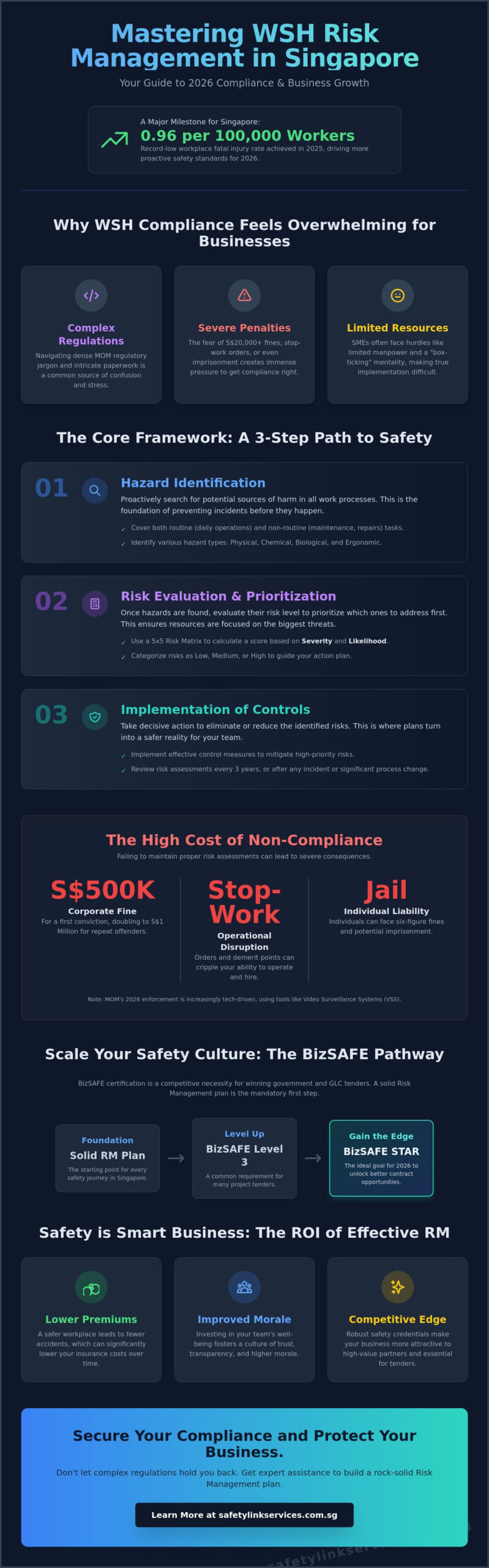
Did you know that Singapore’s workplace fatal injury rate hit a record low of 0.96 per 100,000 workers in 2025? While that’s a major win for the nation, the day-to-day reality of risk management implementation singapore often feels like drowning in MOM regulatory jargon and complex paperwork. You likely feel the pressure of getting your documentation exactly right, especially with the fear of a S$20,000 fine or a sudden stop-work order hanging over your head. It’s common to feel overwhelmed by these requirements, but safety compliance shouldn’t be a barrier to your daily operations or business growth.
This guide simplifies the process by stripping away the confusion and providing a clear, step-by-step framework for business success. We’ll show you how to master the latest WSH Risk Management Regulations without the technical headache. You’ll learn exactly how to secure your BizSAFE Level 3 or STAR certification while building a safer workplace that keeps your team protected and your business running smoothly. We’ll even cover how to handle new requirements, like reporting for platform workers, to ensure your documentation is future-proof for 2026.
Key Takeaways
- Master the three-pillar approach of hazard identification, evaluation, and control to stay ahead of the 2026 WSH Act standards.
- Follow a clear roadmap for risk management implementation singapore businesses need to build effective safety teams and accurate risk assessments.
- Overcome common SME hurdles like limited manpower and “box-ticking” mentalities with practical, hands-on strategies.
- Learn why 2026 is the ideal time to transition from BizSAFE Level 3 to STAR certification for better contract opportunities.
- Avoid costly MOM fines and work disruptions by ensuring your safety plan meets the latest legal requirements.
Navigating Singapore’s WSH Risk Management Regulations in 2026
Under the Workplace Safety and Health (WSH) Act, Risk Management (RM) is a mandatory legal requirement, not a voluntary safety exercise. It involves a systematic process of identifying hazards, evaluating risks, and implementing effective control measures. While these regulations are specific to our local context, they are rooted in global Risk management principles that focus on identifying and mitigating uncertainty. In Singapore, this framework ensures that every person at work goes home safe. Whether you’re an employer, a self-employed person, or a principal, the law places the burden of safety squarely on those who create the risk or have control over the work.
By 2026, the standards for risk management implementation singapore have evolved to become significantly more proactive. Following a record low workplace fatal injury rate of 0.96 per 100,000 workers in 2025, the Ministry of Manpower (MOM) has doubled down on preventative measures. You’re no longer expected to just react to incidents. The current landscape demands that you anticipate hazards before they manifest. This proactive approach is also the bedrock of the bizSAFE program. You cannot achieve BizSAFE Level 3 or the prestigious STAR certification without a rock-solid RM foundation. It’s the starting point for every safety journey in the city-state.
The Role of the WSH (Risk Management) Regulations
The regulations mandate that every workplace conduct thorough hazard identification. MOM’s 2026 enforcement strategy is increasingly tech-driven, utilizing tools like mandatory Video Surveillance Systems (VSS) at specific worksites to ensure compliance isn’t just on paper. If you fail to maintain proper risk assessments, the consequences are severe. Corporate bodies face fines of up to S$500,000 for a first conviction, and repeat offenders can see that figure double to S$1 million. For individuals, the risk includes six-figure fines and potential imprisonment. Beyond financial loss, stop-work orders and demerit points can cripple your ability to hire foreign workers or continue operations.
Why Implementation Matters Beyond Compliance
Viewing risk management implementation singapore as a mere “box-ticking” exercise misses the massive business advantages. A safer workplace naturally leads to fewer accidents, which can significantly lower your insurance premiums over time. It also fosters a culture of trust; when your team sees you investing in their well-being, morale and operational transparency improve. Furthermore, robust safety credentials are a competitive edge. Most government agencies and Government-Linked Companies (GLCs) now require BizSAFE Level 3 or STAR certification as a baseline for any tender submission. Effective RM makes your business more attractive to high-value partners.
The Core Framework: Hazard Identification, Evaluation, and Control
The WSH Council advocates for a robust three-pillar approach to safety. This framework focuses on identifying hazards, evaluating risks, and implementing controls. To make this work for your business, the Risk Management Code of Practice (RMCP) should be your go-to reference. It’s the practical bible for risk management implementation singapore companies use to stay compliant. You don’t need to halt your entire production line for a workplace walkthrough. Instead, integrate safety observations into your daily supervisory rounds. This keeps your operations fluid while ensuring no danger goes unnoticed. Remember, these assessments aren’t “set and forget” documents. You’re legally required to review them every 3 years, or immediately after any incident or significant change in your work processes.
Step 1: Systematic Hazard Identification
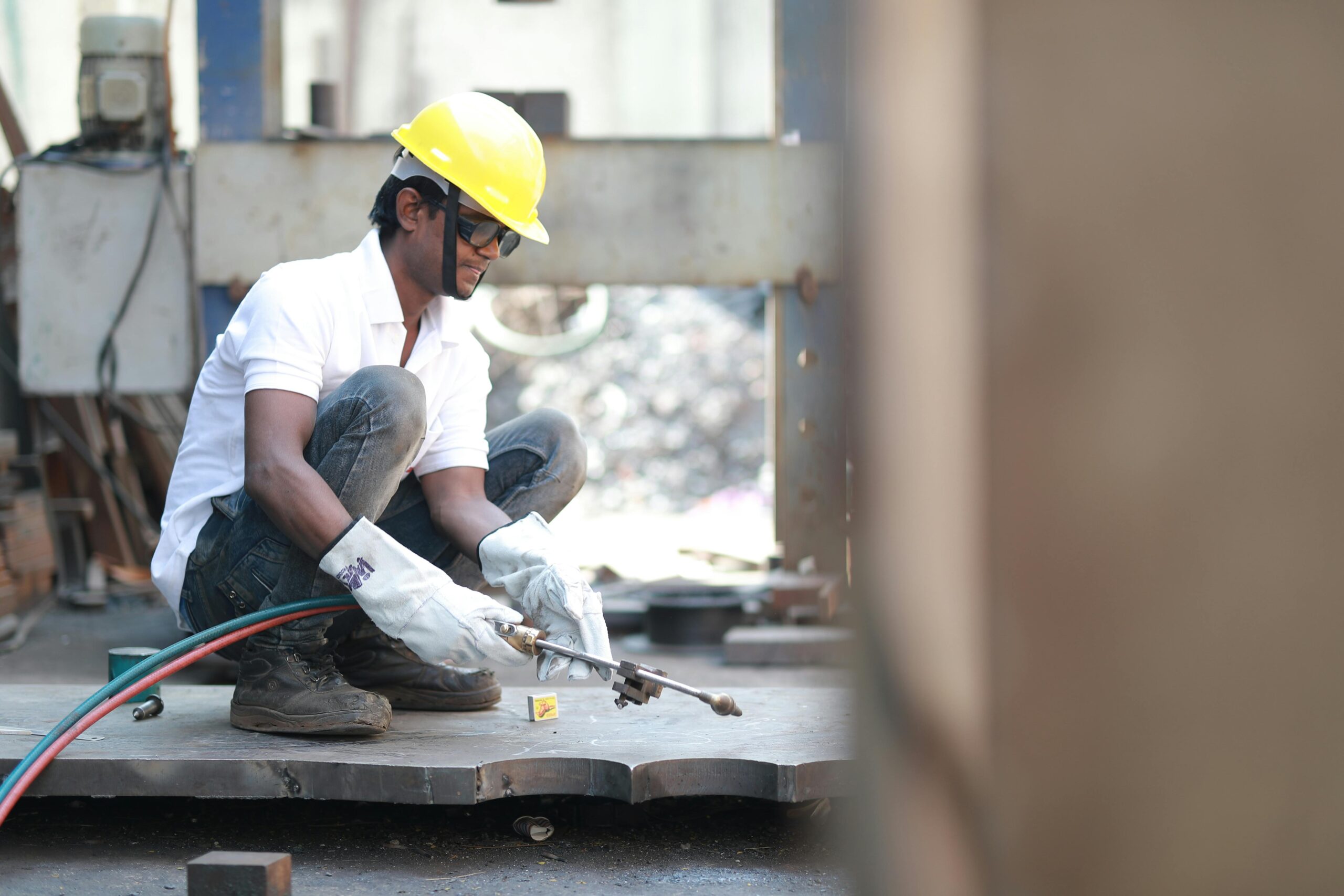
Hazard identification is the proactive search for potential harm in every work process. You must look at both routine activities, like daily machinery operation, and non-routine tasks, such as annual maintenance or emergency repairs. Hazards aren’t always obvious. They can be physical, like trips and falls, or chemical, biological, and ergonomic. If you’re unsure where to start, getting professional Risk Assessment Assistance can help you spot the hidden dangers your team might have become blind to over time.
Step 2: Risk Evaluation and Prioritization
Once hazards are identified, you need to weigh them. Most Singaporean firms use a 5×5 risk matrix to calculate a risk score based on severity and likelihood. This helps you categorize risks into Low, Medium, or High levels. A High risk score is a red flag. It often requires an immediate Stop Work intervention until you can bring the danger down to a manageable level. This prioritization ensures you spend your resources where they’re needed most, protecting your people and your bottom line simultaneously.
Step 3: Implementing the Hierarchy of Controls
The goal is to keep residual risk As Low As Reasonably Practicable (ALARP). You should always try to eliminate the hazard first. If you can’t remove it, substitute it for something safer. Engineering controls, like physical guards on machines, are always more effective than administrative controls, like warning signs. Personal Protective Equipment (PPE) is your last line of defense, not your first. By following this hierarchy, you ensure that your safety measures are reliable and don’t rely solely on human behavior.
Step-by-Step Implementation of Your Risk Management Plan
Moving from the theory of risk matrices to actual risk management implementation singapore businesses can trust requires a clear sequence of actions. It starts with leadership. You’ll need to appoint a Risk Management (RM) Champion who has the authority to allocate resources and the technical grasp to oversee the process. This leader doesn’t work alone; they’ll guide a dedicated RM team through the creation of a work activity inventory. This inventory is a complete list of every task performed on your site, from high-risk machine operation to routine maintenance. By breaking your operations down into these bite-sized activities, you ensure no hazard is overlooked during the assessment phase.
Once your activities are listed, the real work of drafting Risk Assessments (RA) begins. For each task, your team will identify hazards and decide on controls. But the process doesn’t end once the paperwork is signed. You must train every affected employee on the specific controls identified in the RA. If a worker doesn’t know why a certain guard is on a machine or how to follow a new Safe Work Procedure (SWP), the RA is just a piece of paper. Establishing a robust record-keeping system is the final step. This system should track training dates, assessment reviews, and any incident reports, creating a clear paper trail for your BizSAFE audit.
Assembling Your Risk Management Team
A common mistake many SMEs make is forming a team solely of office-based managers. To get a true picture of your workplace, you need a mix of management and frontline workers. Management provides the necessary budget for safety upgrades, while workers provide the “boots on the ground” truth about daily hazards. Sometimes, internal teams can become blind to risks they see every day. Engaging the Provision of WSHE Professionals can provide that critical, unbiased eye. These experts help your team spot subtle dangers and ensure your implementation plan meets the strict standards required for BizSAFE Level 3 or STAR certification.
Documenting the Process Correctly
Documentation is often the “make or break” factor in a successful audit. You must use standardized Risk Assessment Forms and a formal Implementation Plan. A key part of this is writing clear, actionable Safe Work Procedures (SWP). An SWP should be a simple, step-by-step guide that tells a worker exactly how to perform a task safely; it isn’t a place for vague legal language. Many firms fail their audits because they use generic templates found online that don’t reflect their actual work environment. Auditors look for site-specific details, such as the exact model of machinery used or the specific layout of your warehouse, to prove you’ve actually evaluated your own unique workspace.
Common Implementation Hurdles and How to Overcome Them
Even with the best intentions, risk management implementation singapore businesses often face significant roadblocks. One of the most persistent issues is the “Box-Ticking” mentality. When staff and supervisors view safety documentation as a chore rather than a life-saving tool, the quality of your risk assessments drops. This leads to a dangerous gap between what’s on paper and what’s actually happening on the ground. For SMEs, limited manpower is another major hurdle. Your team is likely already stretched thin, and the administrative weight of detailed safety documentation can feel like a breaking point. It’s easy for safety to fall by the wayside when project deadlines loom and resources are tight.
Another challenge is keeping your risk management relevant as project scopes change. A static safety plan is a useless safety plan. If you’re moving into a new phase of construction or adopting new manufacturing technology, your assessments must evolve immediately. Finally, there’s the cost objection. Many business owners worry about the expense of professional safety services. However, when you consider that a single MOM fine for a lack of risk assessment can reach S$20,000 for a first offense, the long-term savings of getting it right from the start become clear. Professional help isn’t just a cost; it’s a safeguard against financial and operational ruin.
Fostering a Positive Safety Culture
To overcome these hurdles, you need to shift from reactive “Risk Management 1.0” to proactive “Risk Management 2.0.” This means you don’t wait for an accident to fix a process. Instead, you encourage near-miss reporting. When workers feel safe reporting a “close call” without fear of retribution, you gain invaluable data to prevent future tragedies. This shift starts at the top. Management commitment is the single most important factor in a successful safety culture. When you lead by example, your team follows, turning risk management implementation singapore into a shared responsibility rather than a management directive.
Streamlining Documentation with Professional Help
You don’t have to carry the administrative burden alone. Our team provides expert Risk Assessment Assistance to help you manage the heavy lifting of documentation. We leverage pre-approved templates and industry-specific benchmarks to ensure your paperwork is both accurate and efficient. This approach allows you to focus on your core business while we ensure your safety files are ready for a BizSAFE Level 3 audit. By partnering with experts, you gain the peace of mind that comes from knowing your compliance is handled by specialists who understand the local regulatory environment inside and out.
Scaling Your Safety Culture: From BizSAFE Level 3 to STAR
Scaling from Level 3 to STAR isn’t just about adding more paperwork. It involves moving from a standalone risk assessment to a fully integrated management system. For many, Level 3 is the necessary entry point. However, as your business grows, you’ll find that larger clients and government agencies increasingly look for the STAR mark. This certification proves you’ve gone beyond the basics of risk management implementation singapore requirements. It shows you’ve adopted a culture of continuous improvement that protects both your workers and your brand’s reputation. In 2026, with national safety standards at an all-time high, standing still is the same as falling behind.
Achieving STAR status puts you in an elite bracket. It opens doors to high-value contracts with major developers who won’t even look at a tender without it. If you’re working with international clients, STAR serves as a globally recognized signal of your commitment to safety excellence. It’s your ticket to larger, more complex projects that demand a higher level of oversight. Integrating your Risk Management plan into a full WSH Management System is a key part of this transition. This integration streamlines your internal audits and significantly reduces the chance of operational surprises that could lead to costly downtime.
The Benefits of BizSAFE STAR Certification
By pursuing BizSAFE level 3 to STAR certification, you aren’t just ticking a box. You’re positioning your company as a top-tier partner in Singapore’s competitive market. Major developers and government-linked companies often prioritize STAR-certified firms because they represent lower liability and higher reliability. This certification also demonstrates a world-class safety standard to international clients, which is essential if you plan to expand your services beyond local shores. It’s a clear statement that your business values human life as much as operational efficiency.
Next Steps: Your Roadmap to Safety Excellence
Ready to move up? Your first move should be a thorough gap analysis of your current operations. This identifies where your current RM implementation falls short of the rigorous STAR requirements. Once you know the gaps, you can set a realistic timeline for your upgrade that doesn’t disrupt your ongoing projects. Don’t feel you have to navigate this transition alone. We can provide a customized consultancy package tailored to your specific project needs, ensuring you have the right WSHE professionals in your corner every step of the way. This hands-on support makes the journey from Level 3 to STAR smooth and predictable. It allows you to focus on winning those next big contracts while we handle the technical complexities of your safety framework.
Building a Resilient Business for 2026 and Beyond
Effective risk management implementation singapore isn’t just a legal chore; it’s a strategic investment in your company’s longevity. We’ve explored how a proactive “Risk Management 2.0” approach helps you stay ahead of MOM’s 2026 enforcement standards. By moving beyond generic templates and focusing on site-specific hazard identification, you protect your people and your bottom line from costly disruptions. Whether you’re maintaining your current standards or scaling from BizSAFE Level 3 to STAR, the goal is always genuine operational health over simple box-ticking.
Don’t let the administrative weight of compliance hold you back. Our team provides MOM-compliant documentation support and on-site consultancy from expert WSHE professionals. We have a proven track record in guiding firms through successful BizSAFE Level 3 to STAR upgrades. Get Expert Risk Assessment Assistance for Your BizSAFE Renewal and gain the peace of mind that comes with professional oversight. You’ve built a great business; let’s work together to make sure it’s a safe and sustainable one too.
Frequently Asked Questions
What is the difference between a Risk Assessment and a Risk Management Plan?
A Risk Assessment is a specific document that identifies hazards for a single work activity, while a Risk Management Plan is the overarching strategy for your entire company. While the assessment focuses on the “what” and “how” of a specific danger, the plan outlines your team’s responsibilities and the schedule for reviews. Think of the assessment as the tactical tool and the plan as your strategic roadmap for risk management implementation singapore safety standards require.
How often must my business review its Risk Management implementation in Singapore?
You are legally required to review your risk management implementation at least once every three years. However, this is the maximum interval allowed under the WSH (Risk Management) Regulations. You must also conduct an immediate review if there’s a significant change in your work processes, an introduction of new machinery, or if a workplace accident occurs. Keeping your assessments current ensures they remain effective protections rather than just outdated paperwork.
Can I implement Risk Management myself or do I need a certified consultant?
You can implement risk management using your internal team, provided they have the necessary training and technical knowledge. Many Singaporean businesses choose to engage external experts for Risk Assessment Assistance to ensure their documentation meets strict MOM standards. This helps avoid common errors that lead to audit failures. Professional guidance provides an unbiased perspective that often spots hazards your daily team might overlook after working in the same environment for years.
What are the specific MOM requirements for a Risk Management Champion?
The Risk Management Champion must be a member of your senior management team who has the authority to make decisions and allocate resources. MOM requires this individual to have the power to approve budgets for safety controls and enforce new protocols across the organization. They act as the bridge between safety theory and operational reality. Without a champion who has real influence, safety initiatives often stall at the supervisor level or face resistance during implementation.
How long does it take to implement a full Risk Management system for BizSAFE Level 3?
Implementing a full Risk Management system typically takes between four to eight weeks for most small to medium enterprises. This timeline allows for thorough hazard identification, team training, and the drafting of Safe Work Procedures. If you’re aiming for BizSAFE Level 3, you’ll also need to account for the time required to conduct an internal audit before the final external assessment. Starting early ensures you aren’t rushing through critical safety checks or missing important documentation.
What documents does a MOM auditor look for during a safety inspection?
A MOM auditor will primarily look for your inventory of work activities, signed Risk Assessment forms, and corresponding Safe Work Procedures. They also check training records to verify that your staff actually understands the controls you’ve put in place. It isn’t enough to have the documents; you must prove they are being used. Auditors often interview workers to see if the “paper safety” matches the actual practices on the shop floor during your daily operations.
Is Risk Management mandatory for all industries in Singapore, including offices?
Yes, risk management is mandatory for every workplace in Singapore under the WSH Act, including low-risk office environments. While an office might not have heavy machinery, it still has hazards like ergonomic strain, electrical risks, or fire safety concerns. Every employer must identify these risks and implement appropriate controls. Neglecting this requirement in an office setting can still lead to fines and legal liabilities if an injury occurs, regardless of the industry type.
How does Risk Management 2.0 differ from traditional safety protocols?
Risk Management 2.0 moves beyond simple compliance to focus on a proactive safety culture and near-miss reporting. Traditional protocols often wait for an accident to happen before making changes to a process. In contrast, the 2.0 approach uses data and worker feedback to fix potential issues before they manifest as injuries. It treats risk management implementation singapore as a dynamic part of business growth rather than a static set of rules to be followed merely to avoid fines.
Related Posts


One Comment
Leave A Comment


Recent Works





[…] must show that risks have been identified, evaluated, and controlled through a functioning risk-management system, not simply recorded in a […]